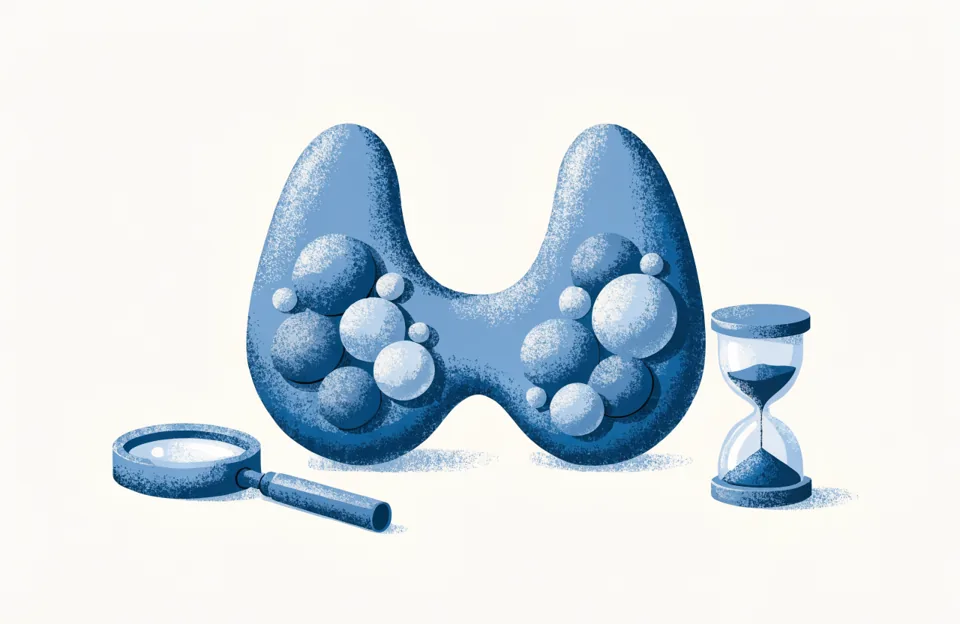
- A benign multinodular goiter that causes no symptoms and does not overproduce hormone is followed with ultrasound, and European and American guidelines agree.
- It is treated when it compresses the structures of the neck, when it shows or grows, when one of the nodules produces hormone independently or when one turns out to be suspicious.
- There are three options, surgery, radioiodine and ablation, and each fits a different goiter, and taking levothyroxine to «shrink it» is not one of them.
Goiter means an enlarged thyroid, and multinodular, that the enlargement is made of several nodules instead of one. The name sounds more serious than it usually is: most of those nodules are benign and many have been present for years without being detected. What follows is how it is decided, at the consultation, whether yours is watched or treated.
Each nodule is evaluated on its own
A multinodular goiter is evaluated nodule by nodule, rather than as a single piece. American guidelines ask that each nodule be evaluated by its ultrasound appearance, not only the largest, because the one that matters is not always the one that measures most. A small nodule with suspicious features weighs more than a large, quiet-looking one. That is why the report should describe every nodule over one centimeter with its A score from 1 to 5 that the radiologist gives each nodule based on its ultrasound appearance. It decides whether a biopsy is needed and from what size., and why sometimes the one biopsied is not the biggest.
When watching is enough
If none of the nodules is suspicious, the gland does not compress or show and the The pituitary hormone that tells the thyroid to produce. If the thyroid overproduces, TSH falls, and if it underproduces, TSH rises. is normal, both guidelines give the same answer: it is not treated, it is followed. The European Thyroid Association records it this way: a benign lesion that causes no symptoms is not treated. Watching means a periodic ultrasound, comparing the volume of each nodule with the previous one, and a blood test now and then. Monitoring is not neglecting it, and it is a medical decision, and very often the right one.
When it needs treatment
- 01When it compressesPressure when swallowing, a choking feeling when lying down, a new cough or throat clearing. A large goiter can also grow down into the chest, behind the breastbone, where it causes symptoms without being visible.
- 02When it shows or growsA neck that changes shape, or nodules that measure more at every follow-up ultrasound. Growth is measured in volume, not in a single diameter.
- 03When it overproduces hormoneOne or several nodules can become autonomous and lower the TSH. That is a toxic multinodular goiter, and it is treated even if it causes no compressive symptoms.
- 04When one is suspiciousA nodule with a high TIRADS or a biopsy that is not benign changes the whole conversation: then it is operated on, by a surgical oncologist.
The three options, and which goiter each one fits
When treatment is needed, there are three paths, and the choice depends on what the goiter is like, not on a preference going in.
- Surgery. Removes the whole gland or one half. It is what is indicated when the goiter is very large, when it extends into the chest, when many nodules cause symptoms at once or when one is suspicious. It resolves the problem in a single procedure, and in exchange, if the whole gland is removed, hormone is taken for life.
- Radioiodine. A capsule of radioactive iodine that the thyroid absorbs and that shrinks the tissue producing excess hormone. It is the guidelines' first option in toxic multinodular goiter when there is no reason to operate. It works over months, not days, and some patients end up hypothyroid.
- Radiofrequency ablation. Shrinks from within the nodule or nodules causing the problem, under local anesthesia and without removing the gland. It fits when one or two dominant nodules are the ones compressing or showing, and they are benign on two biopsies. When there are many nodules and the size of the whole gland is the problem, surgery resolves it better as a whole.
Levothyroxine to «shrink it»: why it stopped being prescribed
For years, thyroid hormone was prescribed to people with a healthy thyroid to try to shrink their nodules. The American guideline expressly advises against it in iodine-sufficient populations: the benefit is small and a TSH suppressed for years has consequences for the heart and the bones. Levothyroxine is prescribed when the thyroid does not produce enough, rather than to shrink a goiter.
- Haugen BR et al. 2015 American Thyroid Association Management Guidelines for Adult Patients with Thyroid Nodules and Differentiated Thyroid Cancer. Thyroid. 2016, 26(1): 1-133.
- Papini E, Monpeyssen H, Frasoldati A, Hegedüs L. 2020 European Thyroid Association clinical practice guideline for the use of image-guided ablation in benign thyroid nodules. Eur Thyroid J. 2020, 9(4): 172-185.
- Ross DS et al. 2016 American Thyroid Association Guidelines for Diagnosis and Management of Hyperthyroidism and Other Causes of Thyrotoxicosis. Thyroid. 2016, 26(10): 1343-1421.
- Kim JH et al. 2017 Thyroid Radiofrequency Ablation Guideline: Korean Society of Thyroid Radiology. Korean J Radiol. 2018, 19(4): 632-655.