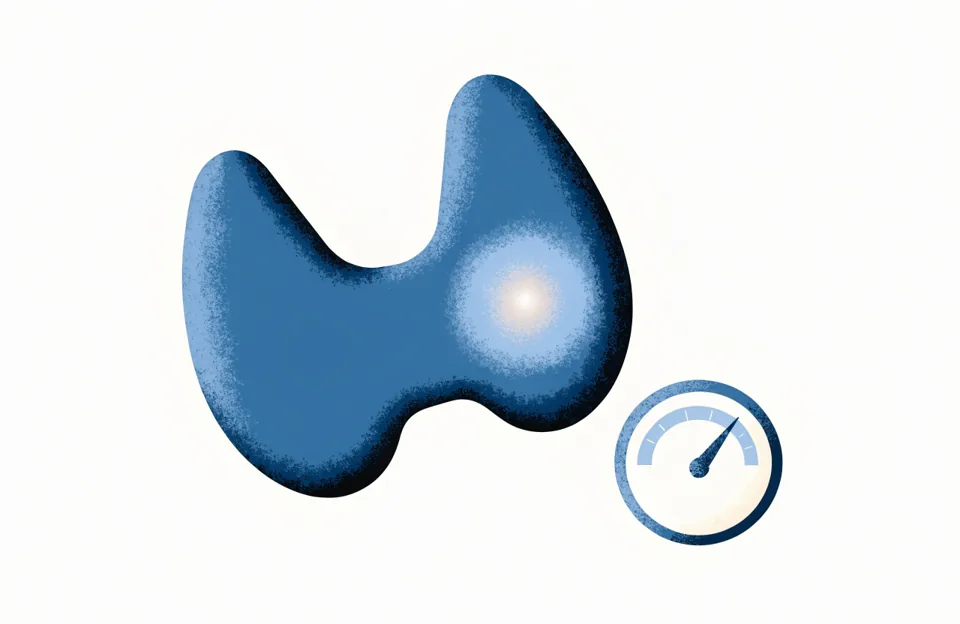
- An autonomous nodule produces hormone without obeying the pituitary, and it is suspected from a low TSH and confirmed with a scintigraphy scan.
- Radioiodine is the European guideline's first option, and surgery, when the nodule is large or there are other reasons, and ablation, when radioiodine is not an option or the patient does not want it.
- With ablation, in the literature the nodule shrinks by about 79 % at one year, but TSH normalizes in only slightly more than half of cases.
A normal thyroid produces hormone when the pituitary orders it to, through The pituitary hormone that tells the thyroid to produce. When a nodule produces on its own, TSH falls.. An A nodule that produces thyroid hormone without obeying the pituitary. On the scan it appears «hot». does not respond to that signal: it produces independently, and the pituitary, faced with excess hormone, stops stimulating the gland. That is why the first clue is almost never a symptom: it is a low TSH on a routine blood test.
How it is known that a nodule is autonomous
Two tests confirm it. The blood test, which shows a low TSH and, sometimes, high T4 or T3. And the An image showing which parts of the thyroid take up iodine. It uses a minimal dose of a radioactive tracer and is not the same as radioiodine treatment., an image that shows which part of the thyroid is taking up iodine: the autonomous nodule appears «hot», fully active, while the rest of the gland appears inactive. That image is what distinguishes an autonomous nodule from any other, and it is what is requested when the TSH comes back low.
One reassuring detail: the autonomous nodule is almost always benign, and the ablation guidelines accept a single benign biopsy instead of the usual two, precisely because the scan already says a lot about it.
Why it is treated even if it does not bother you
Because excess hormone, even mild and without symptoms, has consequences over the years: in the heart, with its rhythm, and in the bones, with their density. The symptoms, when they appear, are those of hyperthyroidism: palpitations, feeling hot, tremor, weight loss, insomnia. But many autonomous nodules are treated before any of that happens, especially in older people, in whom the cardiac risk weighs more.
The options, one by one
- 01Antithyroid medicationIt slows hormone production while it is taken, though it does not resolve the nodule. It is used to prepare for another treatment or for those who cannot receive any of the others.
- 02RadioiodineA capsule of radioactive iodine that only the nodule, the active one, absorbs. It shrinks it and halts its activity over months. It is the European guideline's first option, and some patients end up hypothyroid and take hormone afterwards.
- 03SurgeryThe half of the thyroid containing the nodule is removed. It resolves the problem in a single procedure and provides a specimen for the pathologist. It is what is indicated when the nodule is large, compresses or there is something else to study.
- 04Radiofrequency ablationShrinks the nodule from within, under local anesthesia, and the gland is preserved. It is considered when radioiodine is not an option or the patient does not want it. It reduces volume effectively, and it normalizes the hormone less reliably.
What ablation achieves in this nodule
Here it is worth being exact, because this is where ablation delivers less than in the nodule that only causes compressive symptoms. Reducing the volume, it does well. Halting hormone production entirely depends on treating the whole active part of the nodule, and that is not always achieved in one session.
- 79 %volume reduction at one year in autonomous nodules treated with radiofrequency, in the pooled studies.Cesareo R et al. Rev Endocr Metab Disord. 2019, 20(1): 37-44.
- 57 %of patients normalized their TSH at one year. That is, slightly more than half, and the rest still had excess hormone and needed another treatment or a second session.Same review. It is the figure to have in front of you before choosing this option.
That 57 % is the reason the guidelines put radioiodine first. Ablation makes sense when radioiodine cannot be used or is not wanted, and when it is accepted in advance that a second session or, if that is not enough, another treatment may be needed. At the consultation you are told whether your nodule falls into that case, and why.
- Ross DS et al. 2016 American Thyroid Association Guidelines for Diagnosis and Management of Hyperthyroidism and Other Causes of Thyrotoxicosis. Thyroid. 2016, 26(10): 1343-1421.
- Papini E, Monpeyssen H, Frasoldati A, Hegedüs L. 2020 European Thyroid Association clinical practice guideline for the use of image-guided ablation in benign thyroid nodules. Eur Thyroid J. 2020, 9(4): 172-185.
- Cesareo R et al. Efficacy of radiofrequency ablation in autonomous functioning thyroid nodules. A systematic review and meta-analysis. Rev Endocr Metab Disord. 2019, 20(1): 37-44.
- Kim JH et al. 2017 Thyroid Radiofrequency Ablation Guideline: Korean Society of Thyroid Radiology. Korean J Radiol. 2018, 19(4): 632-655.