
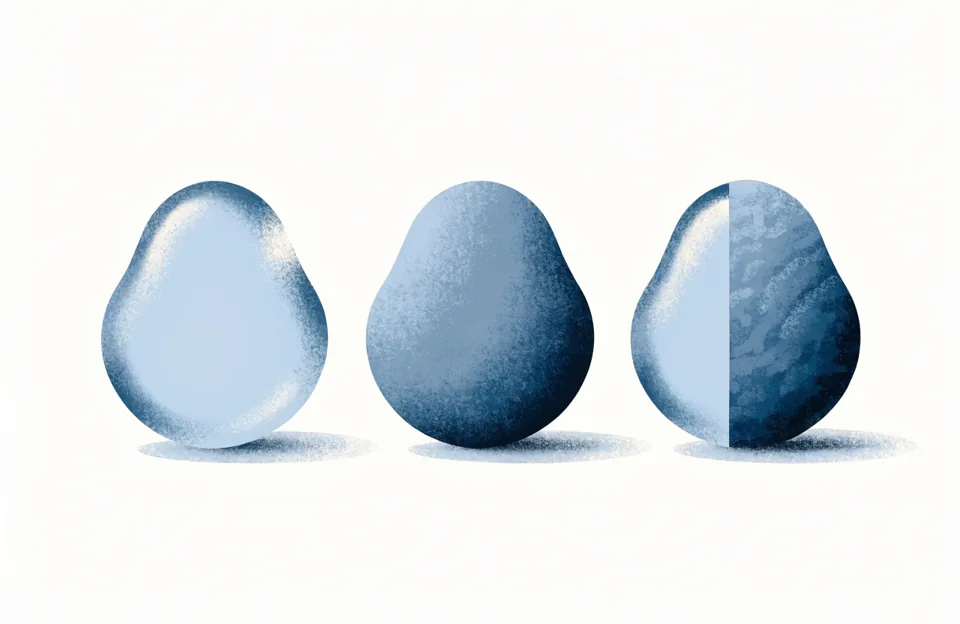
- A nodule is classified by how much fluid it holds: cystic, predominantly cystic or mixed. That proportion decides the technique.
- In the pure cyst, the Korean and European guidelines put ethanol ablation first, and radiofrequency is the next step if it is not enough.
- In the predominantly cystic or mixed nodule, radiofrequency treats the solid part and achieves, in the literature, larger reductions than in the purely solid one.
Draining a thyroid cyst with a needle brings relief the same day, and it almost always lasts a short while: the fluid comes back. That is why two techniques exist to keep it from coming back, and why it helps to know which one fits your nodule before deciding.
First, how much fluid it holds
The radiologist describes the nodule by its proportion of fluid: A nodule filled with fluid, or nearly so. It is usually benign and has its own first line of treatment. when it is almost all fluid, predominantly cystic when fluid is more than half, and mixed or predominantly solid when tissue is the larger part. It is not a curiosity of the report: it is what decides which technique is used, because each acts on a different component of the nodule. Alcohol acts on the wall that produces the fluid, and heat, on the solid tissue.
In the pure cyst: ethanol ablation first
Injection of ethanol into a cystic nodule, guided by ultrasound, so the wall stops producing fluid. consists of draining the cyst and leaving ethanol inside for a few minutes, under ultrasound guidance, so the wall stops producing fluid. It is simpler, shorter and less costly than radiofrequency, and in the pure cyst it works just as well. That is why both guidelines put it first, and why, when radiofrequency is proposed directly for a pure cyst, it is worth asking what that indication is based on.
- 50cystic nodules were randomly assigned to one session of ethanol ablation or one of radiofrequency in the trial that compared them: at six months, ethanol ablation was not inferior.Sung JY, Baek JH et al. Radiology. 2013, 269(1): 293-300.
- 91.1 %mean reduction at final follow-up in cystic nodules treated with radiofrequency, versus 71.8 % in solid ones.Cesareo R et al. Rev Endocr Metab Disord. 2019, 20(1): 37-44. 21 pooled studies.
In the predominantly cystic and the mixed: radiofrequency makes sense
When, besides the fluid, there is a solid part that keeps growing, alcohol does not reach it. That is where radiofrequency is indicated: the fluid is drained and the solid tissue is heated, in the same session. The Korean guideline allows either technique in the predominantly cystic nodule, and recommends radiofrequency when ethanol ablation has already been tried and was not enough. Results in these nodules are among the highest the technique reaches, precisely because the part that has to be heated is small.
Ethanol ablation
- For the pure or nearly pure cyst
- Drains the fluid and treats the wall with ethanol
- Shorter, simpler and less costly
- If the fluid returns, it can be repeated or radiofrequency follows
Radiofrequency
- For the predominantly cystic or mixed nodule with a solid part
- Drains the fluid and heats the solid tissue
- Local anesthesia, outpatient, no incision
- In the literature, the largest volume reductions of the technique
The technique is chosen by what the nodule shows, and sometimes the one that fits is the simpler of the two.
One biopsy may be enough
There is a practical advantage. Nodules with a lot of fluid and with that bright artifact radiologists call a A bright trail behind a dot on the ultrasound. It is associated with colloid content, that is, with a benign nodule., like A nodule with many small spaces, like a sponge. It is considered benign with a high degree of confidence. ones, are considered benign with such confidence that the Korean guideline accepts a single benign biopsy before treating them, instead of the two it requires in the solid nodule. At the consultation you are told whether your nodule falls into that case.
- Kim JH et al. 2017 Thyroid Radiofrequency Ablation Guideline: Korean Society of Thyroid Radiology. Korean J Radiol. 2018, 19(4): 632-655.
- Papini E, Monpeyssen H, Frasoldati A, Hegedüs L. 2020 European Thyroid Association clinical practice guideline for the use of image-guided ablation in benign thyroid nodules. Eur Thyroid J. 2020, 9(4): 172-185.
- Sung JY, Baek JH, Kim KS, et al. Single-session treatment of benign cystic thyroid nodules with ethanol versus radiofrequency ablation: a prospective randomized study. Radiology. 2013, 269(1): 293-300.
- Cesareo R et al. Rev Endocr Metab Disord. 2019, 20(1): 37-44.